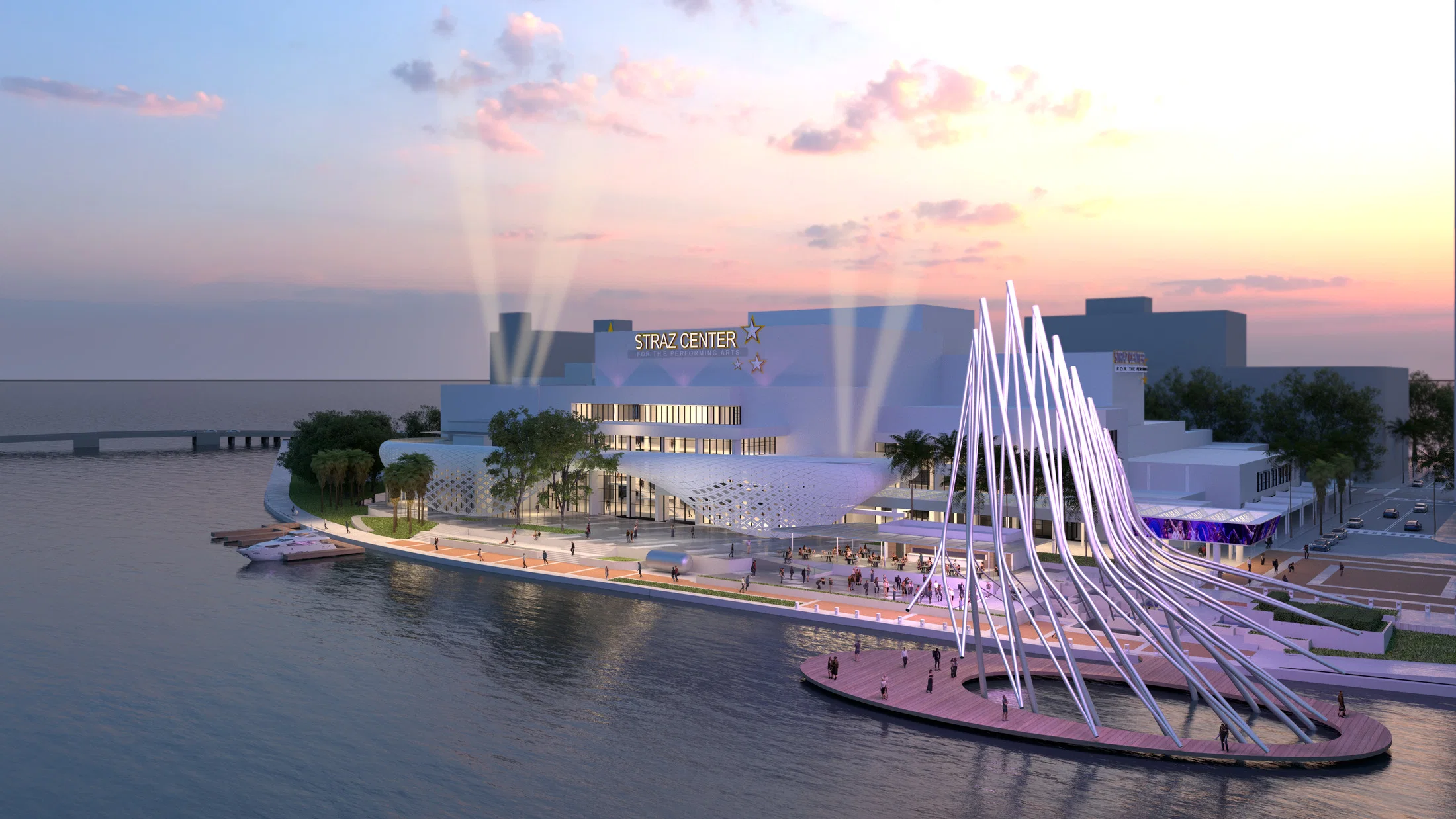
Key Planning Considerations for the Straz Center
- River Arts District location within the downtown convention core
- Synchronization with the performing arts production calendar
- Activation strategies for galas and sponsor receptions
- Coordination with official service contractors and show organizers
- Florida right-to-work labor environment and venue protocols
- Logistical alignment with Tampa Convention Center programs
- Design approaches suited to cultural and entertainment settings
Venue Profile and Downtown Tampa Context
The Straz Center for the Performing Arts anchors a segment of the River Arts District that forms part of Tampa’s primary convention-services cluster. This cluster encompasses Downtown Tampa, Water Street, the Channel District, Harbour Island, and Ybor City, creating a concentrated zone of hospitality, meeting facilities, and event venues. Proximity to the Tampa Convention Center, which offers 600,000 square feet of meeting space and a 200,000-square-foot exhibit hall capable of hosting up to 1,000 10x10 booths, allows organizers to distribute programming across complementary sites without excessive travel for attendees.
Visit Tampa Bay’s meeting planners hub and facilities search resources position the center as a specialized option rather than a primary exhibit location. Its value emerges in the ability to deliver memorable off-site experiences that leverage the arts for sponsor hospitality and attendee engagement. Coordination begins with recognition that the center maintains an active calendar of ticketed performances, requiring precise scheduling to avoid conflicts with rehearsals, load-in for shows, or technical setups inherent to opera, theater, and symphonic productions.
Event planners benefit from the center’s central address at 1010 N. MacInnes Place, which connects directly to riverfront pathways and nearby hotel inventory. This accessibility supports efficient attendee flow from daytime convention sessions to evening receptions without disrupting the sophisticated atmosphere expected at a performing arts venue. All planning remains anchored in official Visit Tampa Bay descriptions and cluster definitions rather than unverified assumptions about physical capabilities.
Suitable Event Formats and Activation Opportunities
The center functions effectively for galas, keynote-adjacent receptions, sponsor events, and entertainment-driven off-site programming that complement larger Tampa trade show or conference agendas. These formats shift focus from booth-centric exhibit halls to experiential environments where branding, interaction, and conversation occur against a backdrop of cultural excellence. Organizers frequently pair the center evenings with daytime programming at the Tampa Convention Center or Water Street hotels to create layered attendee journeys.
Activations at the venue must account for its performing arts identity. Custom displays, modular exhibit components, and interactive installations require refinement to harmonize with architectural features, lighting design, and acoustic standards maintained for Broadway-level productions. Sponsor events gain impact when exhibit elements reinforce thematic messaging without competing with the venue’s core purpose, allowing brands to engage decision-makers in an atmosphere distinct from standard expo floors.
Integration within the downtown cluster enables multi-venue continuity. Attendees can move from exhibit sessions in the convention center’s 200,000 square feet of exhibit space to the center receptions with minimal disruption, provided transportation, timing, and material movement receive advance attention. This approach maximizes the entertainment component while maintaining operational efficiency across the convention core.
Early dialogue with show organizers establishes parameters for permissible activations. The process ensures that all elements align with both the center’s production standards and the event’s overall exhibitor manual.
- Galas and formal networking receptions
- Sponsor appreciation and hospitality functions
- Keynote follow-on entertainment programming
- Themed cultural experience nights
- Award and recognition ceremonies
Logistics Planning and Operational Coordination
Successful events at the center depend on structured coordination that begins with consultation of Visit Tampa Bay resources and the venue’s established planning pathways. Load-in procedures, technical requirements, and scheduling must be confirmed well in advance to accommodate the center’s dual role as both public performance venue and private event host. Material handling follows routes consistent with downtown riverfront constraints and the venue’s internal infrastructure.
The Downtown / Water Street cluster context influences logistics at every stage. Proximity to hotels on Harbour Island and along Water Street simplifies room block management and attendee movement, yet requires attention to traffic patterns around MacInnes Place during peak convention periods. Coordination with the official service contractor designated by the show organizer ensures compliance with all venue-specific rules regarding utilities, setup, and teardown timelines.
Exhibitor-appointed contractors operate within the parameters established by the event manual and Florida regulations. Planners prioritize early confirmation of allowable scopes to prevent misalignment between house services and outside support. This disciplined approach maintains program integrity while respecting the performing arts calendar that governs space availability at the center.
Labor Environment and Regulatory Considerations
Florida maintains right-to-work status under its constitution, establishing an open-market labor baseline rather than default union mandates at venues across the Tampa region. This framework applies to the center and supports flexibility for exhibitors when determining staffing for activations, displays, and related event components. However, specific labor conditions remain governed by the individual event’s exhibitor manual, the official service contractor, and any house rules maintained by the venue.
Tampa programs, including those incorporating the center, routinely require confirmation of utility services, catering protocols, and operational responsibilities with both the organizer and the facility. The Visit Tampa Bay convention center documentation illustrates this pattern through references to on-floor services and planner support functions, a practice that extends to special-event venues. Early alignment prevents downstream complications and supports compliant execution.
Organizers should reference the event-specific manual for binding instructions rather than assume uniform conditions across the market. This remains true whether the program centers on reception displays or more technical integrations. The right-to-work environment provides a foundation, yet final determinations rest with the show organizer and the center operational team for each dated event.
Resources from Visit Tampa Bay and the Florida State Fairgrounds planning sections reinforce the importance of following published workflows. Similar logic applies to the center, where planner guidance emphasizes structured coordination over ad-hoc assumptions.
- Reference the official exhibitor manual for labor rules
- Confirm house service scopes with the organizer
- Align all staffing with event-specific directives
- Understand right-to-work implications without assuming unrestricted access
Integration Within Tampa’s Broader Venue Ecosystem
The center operates as one element within a diversified Tampa meeting market that spans the Downtown convention core, Westshore airport corridor, East Tampa fairgrounds district, and northern suburban resorts. Its cultural focus complements the Tampa Convention Center’s scale and the hospitality inventory along Water Street, enabling organizers to construct programs that blend education, exhibition, and entertainment without relying on a single location.
Nearby assets such as the Tampa Museum of Art and JW Marriott Tampa Water Street expand options for multi-venue strategies inside the same cluster. The Florida State Fairgrounds to the east supplies large-format expo capacity while Saddlebrook Resort to the north accommodates post-event retreats. This spectrum allows precise matching of each segment of an event to the most suitable environment, with the center filling the role of refined cultural and social centerpiece.
Visit Tampa Bay’s dedicated meeting planners hub supplies maps, facilities search tools, and RFP support that streamline selection across these clusters. Planners referencing these official channels gain accurate data on connectivity, capacity characteristics, and operational realities rather than generalized overviews. The center’s River Arts District address enhances its utility for downtown-centric programs that prioritize attendee experience and sponsor visibility.
Design and Implementation Best Practices
Exhibit and activation design for the center prioritizes aesthetic alignment with a performing arts environment. Refined materials, integrated lighting, and technology solutions that enhance rather than dominate the space tend to produce stronger outcomes in gala and reception settings. Custom modular systems allow adaptation to specific room configurations while maintaining brand consistency with daytime exhibit elements deployed at the Tampa Convention Center.
Implementation timelines must synchronize with the venue’s performance schedule to ensure adequate setup windows and orderly removal of materials. Technical compatibility with house audio-visual and production systems prevents disruptions during sponsor presentations or interactive segments. All elements undergo review against venue guidelines to maintain safety and operational standards established for the facility.
Post-event assessment of attendee interaction within the center environment informs iterative improvements for subsequent programs. The venue’s distinctive character frequently encourages creative approaches that differentiate sponsor activations from standard trade show displays, creating lasting impressions that reinforce conference objectives.
Throughout the design and build process, coordination with the show organizer and any designated contractors remains essential. This collaborative model leverages the strengths of the downtown Tampa cluster while delivering compliant, impactful results at the center.
- Select refined materials suited to cultural settings
- Verify technical compatibility with venue systems
- Schedule setup and removal around performance calendar
- Measure engagement to refine future activations
Frequently Asked Questions
Q: What is the address and contact information for the Straz Center for the Performing Arts?
The center is located at 1010 N. MacInnes Place in Downtown Tampa within the River Arts District. The published phone number is (813) 229-7827. Visit Tampa Bay listings confirm this information and position the center as a key cultural resource for meeting planners.
Q: What types of events work best at the this work?
The venue suits galas, keynote-adjacent receptions, sponsor events, and entertainment-driven off-site programming. These formats leverage the performing arts setting to enhance trade show and conference experiences held primarily at the Tampa Convention Center and surrounding downtown properties.
Q: How does the program fit into Tampa’s downtown convention cluster?
Located in the Downtown Tampa / Water Street / Convention Core cluster, the center connects to the Tampa Convention Center, Water Street hotels, Channel District, and Harbour Island. This placement supports multi-venue programs that combine exhibit hours with cultural and social components.
Q: Is Florida a right-to-work state and how does that affect this service events?
Yes, Florida is a right-to-work state per its constitution. This creates an open-market labor environment, but specific rules for any the center event are set by the show organizer, exhibitor manual, and venue policies. Early confirmation with all parties is required.
Q: How far in advance should planners begin the plan coordination?
Coordination should begin 12 to 18 months prior for major programs to align with the performing arts calendar, secure dates, and complete technical and operational planning. Official Visit Tampa Bay resources provide initial guidance for the process.
Q: Can traditional trade show exhibits be installed at the this work?
The center functions primarily as a performing arts venue rather than a dedicated exhibit hall. Custom activations, refined displays, and branded experiences designed for reception and gala environments deliver the strongest results when integrated with larger Tampa convention programs.